
细胞凋亡检测(TUNEL法)
▌ 项目介绍:
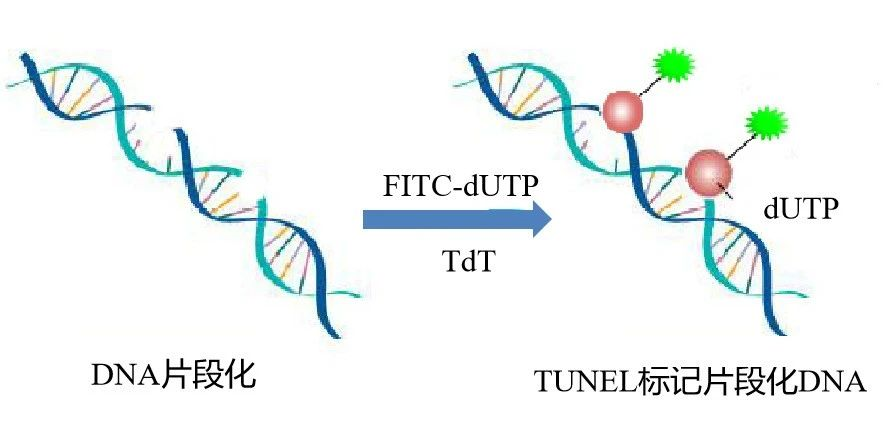
细胞凋亡检测(TUNEL法)是一种基于DNA断裂检测的常用技术,用于评估细胞凋亡的发生和程度。TUNEL法的原理是利用末端脱氧核苷酸转移酶(TdT)将荧光标记的dUTP连接到凋亡细胞中DNA断裂处的3'-OH末端,通过荧光显微镜观察荧光信号,从而实现对凋亡细胞的可视化。该方法具有高灵敏度和特异性,能够检测到单个凋亡细胞,适用于多种样本类型,包括组织切片和细胞培养。TUNEL法的优点包括操作简便、可定量分析以及兼容多种检测平台(如荧光显微镜和流式细胞术)。然而,其局限性在于无法区分凋亡和其他导致DNA断裂的细胞死亡形式,因此常需结合其他方法(如Annexin V检测)以提高准确性。TUNEL法广泛应用于细胞凋亡机制研究、药物筛选、疾病诊断以及基因表达调控等领域。
▌ 案例:
[1] Duan WR, Garner DS, Williams SD, Funckes-Shippy CL, Spath IS, Blomme EA. Comparison of immunohistochemistry for activated caspase-3 and cleaved cytokeratin 18 with the TUNEL method for quantification of apoptosis in histological sections of PC-3 subcutaneous xenografts. J Pathol. 2003 Feb;199(2):221-8. doi: 10.1002/path.1289. PMID: 12533835.
[2] Ray SK. TUNEL-n-DIFL Method for Detection and Estimation of Apoptosis Specifically in Neurons and Glial Cells in Mixed Culture and Animal Models of Central Nervous System Diseases and Injuries. Methods Mol Biol. 2024;2761:1-26. doi: 10.1007/978-1-0716-3662-6_1. PMID: 38427225.
[3] Loo DT. In situ detection of apoptosis by the TUNEL assay: an overview of techniques. Methods Mol Biol. 2011;682:3-13. doi: 10.1007/978-1-60327-409-8_1. PMID: 21057916.
;)